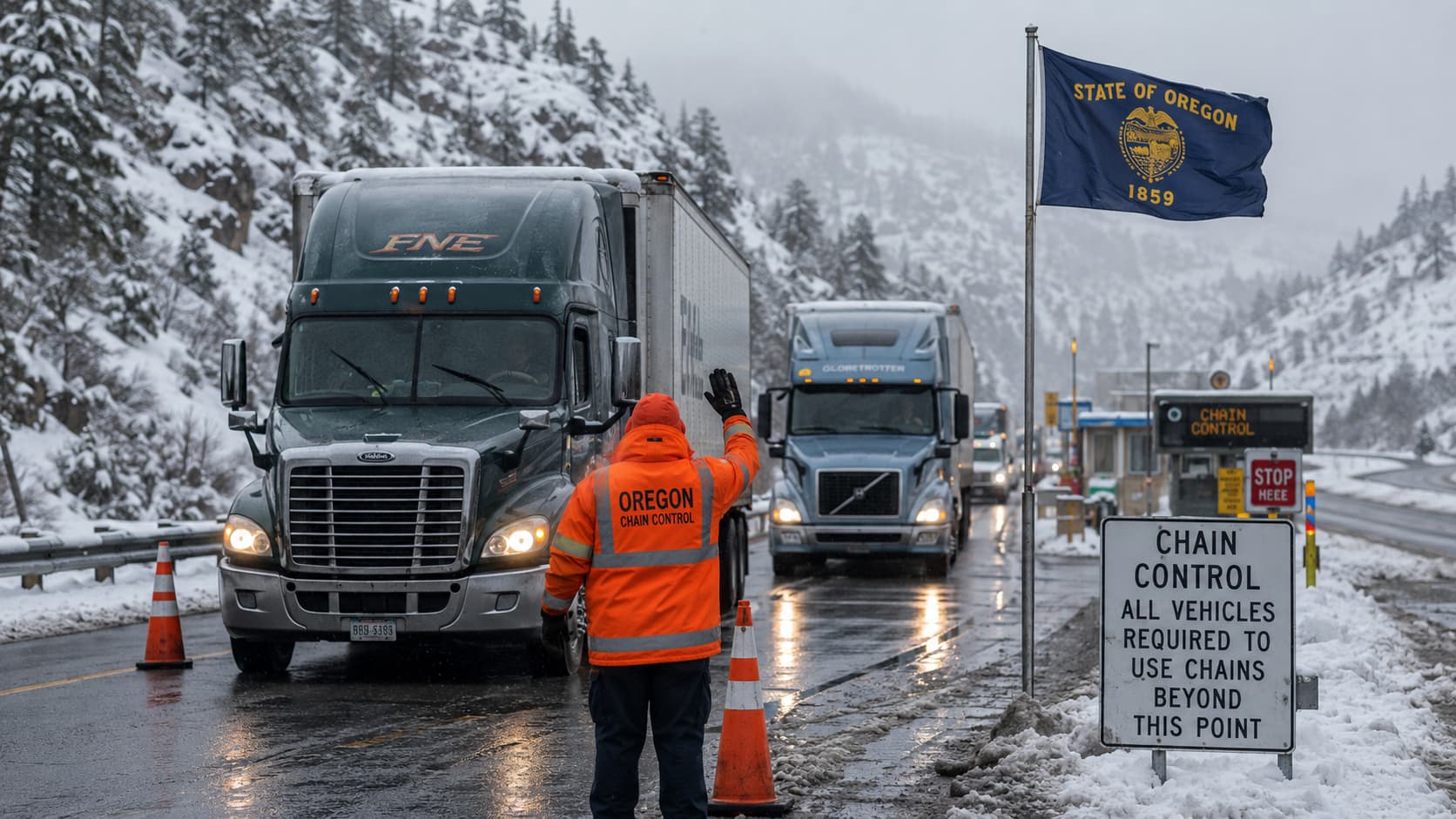
OREGON — Winter is back on Oregon's mountain passes, and so is the state's chain law. When the signs say chains, every truck over 10,000 pounds has to have them on. One truck that spins out on an icy grade can shut the road for everyone behind it.
The ticket is $880. For an independent trucker, that's usually the smallest part of the bill.
What Oregon requires
Any commercial vehicle over 10,000 pounds GVW has to carry chains whenever conditions might call for them and Snow Zone signs are posted. When signs say chains are required, you have to put them on right away, not at the next exit.
Where they go depends on your setup. For the most common one, a tandem-drive tractor pulling a semitrailer, it looks like this:
If both drive axles are powered, you can chain one tire on each side of each drive axle instead. That's still 4 drive tires.
- Drive tires: two tires on each side of the primary drive axle, or one on each side of each drive axle if both are powered.
- Trailer: two tires, one on each side, on any axle of the semitrailer.
A bobtail or straight truck over 26,000 pounds that isn't towing only needs the drives chained. Doubles and triples need more. TripCheck has the full chart for every setup. The chains also have to fit your tires and cover every position the rule calls for. Two chains in the side box won't help when you need six.
What getting it wrong costs
The Oregon Legislature raised the fine for trucks that don't chain up to $880 in 2021, and it's still $880. If a truck without chains ends up in a crash, the penalties go up from there.
The fine isn't what hurts most. A truck stuck on a grade means hours or even a day lost, a missed delivery window, possibly a tow or recovery bill, and a payor who remembers you were late. ODOT estimates that trucks not following the chain law cause more than $8 million a year in delay costs, for carriers and everyone else on the road.
How one mistake wipes out a load
Here's an example. Put in your own numbers.
Anything past the dashed line comes out of your pocket. This example leaves out towing, downtime and the missed reload.
The fine alone turns a $500 load into a $380 loss, and that's before towing, the lost day, or the reload you missed while you were stuck. In winter, a load that looks good on the rate confirmation only pays if you're ready for the road.
Before you head into the mountains
- Check TripCheck before you accept the load, not when you're already at the pass. It shows chain requirements, Snow Zone notices, closures and live pass cameras. You can also call 511 inside Oregon, or 503-588-2941 from out of state.
- Count your chains for your exact setup: drive tires plus the trailer. Pick up an ODOT Chain Information Card at any port of entry if you're not sure.
- Practice once in a dry lot. Learning to chain up on the shoulder of a snowy grade is slow and dangerous.
- Chain up early, at a designated chain-up area or another safe, level spot. Wear reflective gear and stay out of the travel lane.
- Add the time to your trip plan. Count chain-up stops and slower mountain miles before you agree to a delivery time.
Oregon's chain law is about safety first, but for an independent trucker it's also about whether the load makes money.
Sources: ODOT, Tips for Commercial Vehicle Drivers · OAR 734-017-0010, Minimum Chains Required · ORS 815.140. The load example uses made-up numbers; plug in your own.